
Your First Sales Hire Won’t Fix a Broken Go-to-Market System
Why early traction is not the same as repeatable sales and the five things B2B tech founders should validate before hiring.
By Adrijana Daragon | GTM Advantage | October 2026
The short answer
Hiring a salesperson can accelerate a sales process that already works. It rarely fixes an unclear ideal customer profile, unproven messaging, weak qualification or a pipeline dependent on the founder’s personal network. Before hiring, document what makes customers buy, test whether someone else can execute it and define the role the new hire is meant to play.
The first sales hire trap
I see a recurring pattern in founder-led B2B tech companies. The founder has won customers. The product works. There is traction — but growth remains inconsistent. Hiring a salesperson feels like the obvious next step.
Three months later, the founder is still joining discovery calls, rewriting outreach, explaining which prospects matter and rescuing nearly every serious opportunity. The salesperson is busy. The founder is busier. The company has added cost, but not a repeatable way to win customers.
The problem was not necessarily the person hired. It was the expectation that one hire would discover the market, establish the positioning, build demand, qualify opportunities and close deals — all at once.
Founder-led sales creates valuable evidence — and a dangerous illusion
Jason Lemkin of SaaStr recommends founders close their first roughly 10–20 paying customers to understand how selling works before expecting a sales team to scale it. That is a useful starting point, not a universal numerical threshold. Source: https://www.saastr.com/should-a-startup-founder-handle-sales-when-first-getting-started/
I would add a critical distinction: closing 20 customers does not automatically mean you have a repeatable sales system. Some of those deals may have depended on the founder’s reputation, personal introductions, technical authority or willingness to customise the offer. Those advantages can be real — but they do not transfer automatically to a new salesperson.
The test is not simply “Have we sold?” It is “Can someone other than the founder recognise a good-fit opportunity, create a credible conversation and move it forward using a process the company understands?”
Five signs your GTM system is not ready to scale
1. ICP: The founder is the qualification engine
If every promising lead must be reviewed by the founder, your ideal customer profile is not operational. Define firmographic fit, buying roles, use cases, disqualifiers and observable buying signals. Ask a teammate to score ten recent opportunities independently. Compare their decisions with yours.
2. Urgency: Interest is mistaken for intent
Positive feedback, demos and pilot requests are not equivalent to a buying decision. Record what changed inside the buyer’s business: a compliance deadline, budget cycle, new executive, cost pressure, growth target or failed alternative. Ask what happens if they do nothing.
3. Messaging: The founder still explains the value
If prospects understand the product only after the founder joins, the sales story is not transferable. Create a short problem–impact–proof narrative, tailored to the economic buyer. Test it in real conversations, not just internal reviews.
4. Conversion: The pipeline has stages but no evidence
A CRM stage called “proposal sent” is not a buying signal. Define the exit criteria for each stage: a confirmed problem, identified stakeholders, agreed next step, decision process and mutual timing. Review lost and stalled deals, not just wins.
5. Repeatability: Deals still depend on introductions
Separate network-sourced wins from customers acquired through repeatable channels. Can the team generate and advance qualified opportunities from target accounts where the founder has no personal relationship? A few successful experiments matter more than a large volume of unqualified activity.
A practical pre-hire readiness scorecard
Use the table as a diagnostic, not a scientific benchmark. Score each dimension 0 (unknown), 1 (partly documented) or 2 (tested by someone other than the founder).
Dimension | Evidence to request | Score |
ICP | A written account/buyer definition and consistent qualification | 0 / 1 / 2 |
Urgency | Documented buying triggers in recent won and lost deals | 0 / 1 / 2 |
Messaging | Non-founder can deliver value narrative and handle core objections | 0 / 1 / 2 |
Conversion | Clear stage criteria and a reviewed loss/stall pattern | 0 / 1 / 2 |
Repeatability | Qualified opportunities outside founder introductions | 0 / 1 / 2 |
Interpretation: 0–3 suggests foundational GTM work; 4–7 suggests a limited, tightly scoped pilot; 8–10 suggests stronger readiness to scale a defined role. These are advisory heuristics, not validated industry cutoffs.
What should the founder hire first?
What is actually missing | Better immediate response |
Clear demand and a proven process, but too many deals for the founder | Hire an account executive who has sold similar deal sizes and buying motions. |
Target accounts are known, but the team cannot generate enough qualified conversations | Test a focused outbound or demand-generation motion; consider an SDR or specialist support. |
Good conversations but poor conversion and inconsistent messaging | Fix qualification, positioning, sales materials and stage discipline before expanding headcount. |
Too many markets, buyers and use cases competing for attention | Prioritise one ICP and one buying motion; a generalist hire will not solve strategic ambiguity. |
Founder cannot explain why past customers bought | Run structured win/loss interviews and extract founder knowledge into a usable playbook. |
There is no universal rule that every company must hire a salesperson at a particular ARR or customer count. Hiring readiness depends on deal size, sales cycle, inbound demand, implementation complexity, founder capacity and the specific role being hired.
A 30-day plan to make founder-led sales transferable
Week 1 — Reconstruct the deals
Review the last 10–20 won, lost and stalled opportunities. Record source, buyer, trigger, objections, deal size, time to decision and founder involvement.
Week 2 — Narrow the ICP and sharpen the message
Choose a priority segment. Document buying roles, exclusions, core commercial problem, proof points and the language customers actually use.
Week 3 — Build the minimum viable sales playbook
Write qualification questions, discovery outline, follow-up examples, stage exit criteria, objection handling and ownership rules. Keep it short enough to use.
Week 4 — Test without the founder
Have another team member run a small number of carefully selected conversations. Observe where they get stuck. Improve the system before increasing activity.
What to measure before and after the hire
·Qualified opportunities created from non-founder channels, not just meetings booked.
·Conversion from discovery to a mutually agreed next step.
·Percentage of opportunities with a named buyer, urgency trigger and decision process.
·Founder time required per opportunity and per closed deal.
·Win rate and sales-cycle duration by ICP and lead source, using sufficiently large samples before drawing conclusions.
When hiring early can still be the right call
A first salesperson can help discover and refine the motion, particularly when the founder has validated the customer problem but lacks capacity to run structured experiments. The key is to hire for learning and execution, not pretend the role is scaling an already proven engine. Set realistic milestones and provide direct founder coaching. Some companies will benefit more from a hands-on commercial generalist or GTM operator than a traditional quota-carrying closer.
Frequently asked questions
When should a B2B SaaS startup hire its first salesperson?
When it can describe a credible ICP, buying trigger, value proposition and sales process — and can define exactly which activities the new hire will own. Founder capacity and deal economics also matter.
How many customers should founders close before hiring sales?
Jason Lemkin recommends roughly 10–20 as a learning principle, but customer count alone is insufficient. Check whether the learning is documented and transferable.
Why does a first sales hire fail?
Common causes include unclear targeting, no demand-generation motion, inconsistent qualification, unrealistic ramp expectations, poor coaching and an undefined handoff from the founder.
What is the difference between founder-led sales and a repeatable sales process?
Founder-led sales relies heavily on the founder’s personal expertise and relationships. A repeatable process makes targeting, messaging, qualification and deal progression usable by other team members.
Should we hire an SDR or account executive first?
It depends on the bottleneck. An SDR can help create qualified conversations when targeting and outreach are proven; an AE can help advance and close deals when sufficient demand and a defined process already exist.
Can a CRM solve founder dependency?
No. A CRM can make the process visible and accountable, but it cannot define your market, validate urgency or create compelling messaging for you.
The real milestone
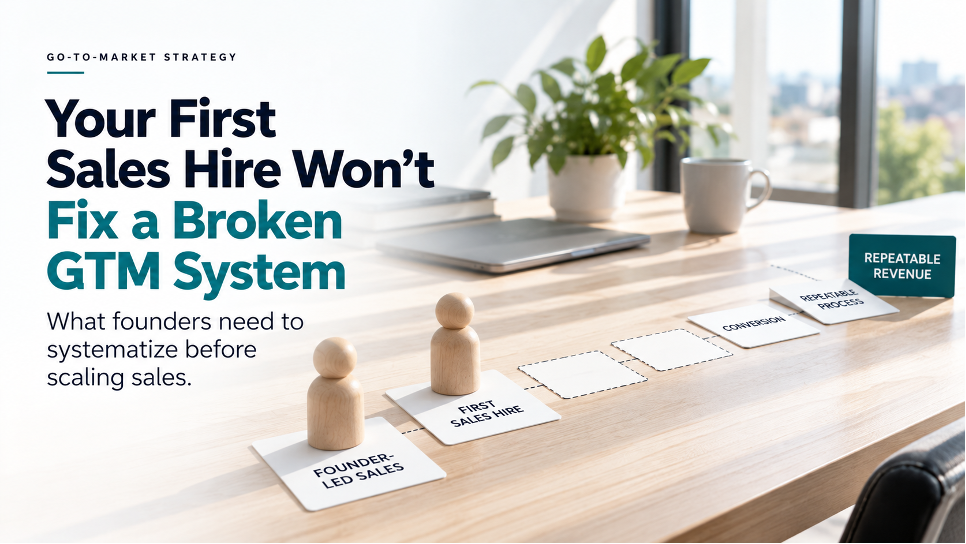
The milestone is not hiring your first salesperson. It is getting customers through a process that someone else can repeat — without the founder having to rescue every step. Build that system, then hire to strengthen it.
If you are moving beyond founder-led sales and want to identify what is blocking repeatable pipeline, explore GTM Advantage:
Reference
Jason Lemkin, SaaStr, “Should a Startup Founder Handle Sales Themself When First Getting Started?” https://www.saastr.com/should-a-startup-founder-handle-sales-when-first-getting-started/