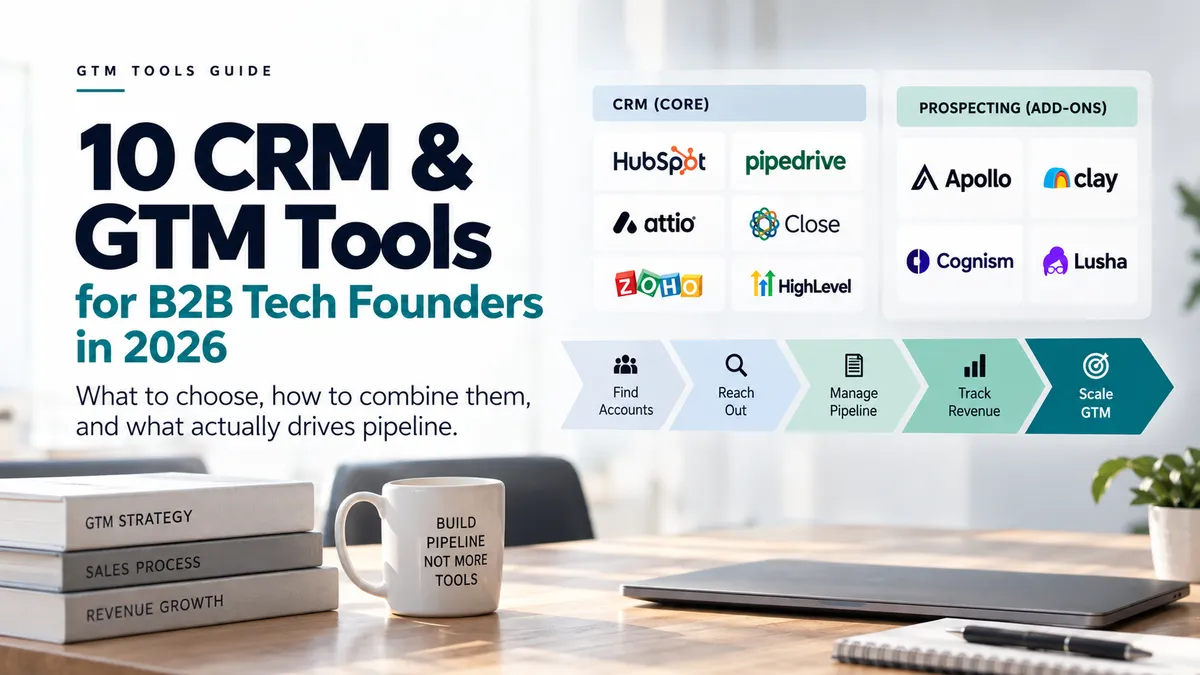
10 CRM & GTM Tools for B2B Tech Founders in 2026
The short answer: which CRM should a B2B startup choose?
For most founder-led B2B tech startups, Pipedrive is a practical choice for simple sales pipeline management; HubSpot is worth evaluating when inbound marketing, forms, content and sales reporting must connect; Attio suits relationship-heavy account-based sales; and Close suits outbound-intensive sales teams. These are fit-based recommendations, not universal rankings. Choose the system that matches how your customers buy and that your team will actually maintain.
Add a prospecting platform only after you have a defined ideal customer profile (ICP), qualification rules and a clear next step for every deal. Apollo, Clay, Cognism and Lusha solve different data and outreach problems; they are not substitutes for a CRM.
Why your first CRM decision is a GTM decision
Your first 100 customer conversations can live in an inbox, calendar and the founder’s memory. The problem appears when a first sales hire joins, a webinar generates leads, or outbound starts. Suddenly nobody can reliably answer: which accounts fit our ICP, who owns the next step, which deals are real, and what created them?
I often see teams add software to solve what is fundamentally a decision problem: too many target segments, unclear qualification and no agreed definition of pipeline. Technology can make a working motion more repeatable. It cannot decide which market to pursue or turn polite interest into buying urgency.
The two layers of a lean GTM stack
MID-ARTICLE VISUAL: A lean B2B GTM stack — one CRM as the system of record, optional prospecting enrichment, and a single pipeline-to-revenue reporting loop.
1. System of record: the CRM owns accounts, contacts, opportunities, stages, activities and closed-won revenue. 2. Prospecting layer (optional): an enrichment or outreach platform helps identify and reach right-fit buyers. Keep website forms, calendar, email and reporting connected to the CRM rather than building competing databases.
Quick comparison: six CRMs and four prospecting tools
Tool | Category | Best fit | Main consideration |
HubSpot | CRM | Inbound + sales alignment | Marketing contact tiers and paid upgrades |
Pipedrive | CRM | Small sales teams, clear pipeline | Marketing attribution and add-ons need checking |
Attio | CRM | Relationship-led, multi-contact B2B deals | Requires deliberate data model |
Close | CRM | Outbound-heavy calling and email | Less naturally content-marketing-led |
Zoho CRM | CRM | Cost-conscious customizable operations | Setup and governance effort |
HighLevel | CRM / marketing platform | Appointment-led sales and agencies | Fit for complex enterprise sales is weaker |
Apollo | Prospecting | Contact discovery + outbound | Data quality, deliverability, CRM sync |
Clay | Prospecting / enrichment | Account research and enrichment workflows | Usage costs and workflow complexity |
Cognism | Prospecting / data | European contact-data workflows | Coverage and commercial terms vary |
Lusha | Prospecting / data | Targeted contact enrichment | Test accuracy by ICP and geography |
The six core CRMs: what to choose and when
1. HubSpot
Best for: Inbound marketing, webinars, content and sales in one lifecycle. Useful when marketing-generated contacts must connect to qualified deals and revenue.
Watch-out: Evaluate paid automation, reporting, seats and marketing-contact billing over 12–24 months.
Decision rule: Choose when you need the marketing-to-sales handoff more than the cheapest sales-only pipeline.
2. Pipedrive
Best for: Two-to-five-person sales teams that need pipeline discipline. Visual stages, activities and follow-up ownership make it easy to establish basic hygiene.
Watch-out: Review integrations, add-ons and whether attribution requirements need separate tools.
Decision rule: Choose when deal progression is the bottleneck and implementation speed matters.
3. Attio
Best for: Account-based and relationship-led B2B sales. Flexible account/contact structures can help teams understand multiple stakeholders.
Watch-out: Flexibility demands consistent fields, definitions and governance.
Decision rule: Choose when mapping people and organizations is central to your selling motion.
4. Close
Best for: Outbound-intensive teams. Calls, emails and sales follow-up are close to the core workflow.
Watch-out: Check fit if content, lead magnets and complex lifecycle marketing are primary.
Decision rule: Choose when rep productivity and outbound execution are the immediate priority.
5. Zoho CRM
Best for: Teams needing customization with a named administrator. A broad configurable CRM option for teams prepared to manage setup.
Watch-out: Low software cost can be offset by internal administration and maintenance.
Decision rule: Choose only if someone will own configuration and data quality.
6. HighLevel
Best for: Short, appointment-led acquisition journeys. Combines landing pages, booking and marketing automations.
Watch-out: Multi-stakeholder enterprise opportunity management may need a different approach.
Decision rule: Choose when bookings and nurture workflows matter more than account complexity.
Four prospecting tools: when an add-on earns its cost
7. Apollo
Contact discovery and outbound sequences. Measure qualified replies and opportunities, not messages sent; protect customers and open deals from prospecting sequences.
8. Clay
Multi-source account research, enrichment and trigger-based workflows. Start with one narrow use case, such as companies hiring their first sales leader; set credit and enrichment limits.
9. Cognism
Contact intelligence for teams that depend on European phone outreach. Sample the exact countries, seniority levels and verticals you target before committing.
10. Lusha
Filling gaps in named prospect lists. Test small samples before purchasing large credit allocations.
Which stack fits your stage?
Founder + first sales hire
Start with a simple CRM, one shared pipeline, email/calendar sync and weekly opportunity review. Usually no enrichment tool is needed yet.
Early traction + inbound demand
Prioritize CRM/form integration, lifecycle definitions and source-to-opportunity reporting. HubSpot may fit if marketing and sales share workflows.
Outbound-led B2B SaaS
Use a CRM as the source of truth; test one prospecting tool only after ICP, targeting and messaging are validated.
Enterprise or regulated tech
Prioritize account relationships, buying committees, procurement milestones, security requirements and long-cycle forecasting. CRM selection should reflect those realities.
The five dashboard numbers founders actually need
Right-fit accounts created
Count ICP-qualified new accounts, not all form submissions or imported contacts.
Response time
Measure time to follow-up on high-intent inquiries.
Stage conversion
Track movement from first conversation to qualified opportunity, proposal and closed-won.
Actionable pipeline
Show deal value with a named owner, next step and credible expected decision date.
Revenue by source
Compare won revenue from referrals, outbound, content, partnerships and events.
A practical 30-day CRM implementation plan
Week 1 — Decide
Define ICP, account tiers, lead vs opportunity, stage exit criteria, ownership and minimum fields.
Week 2 — Configure
Set up pipeline, import clean records, deduplicate contacts and connect calendars, email and forms.
Week 3 — Run live
Use the CRM for real deals; review stalled opportunities and missing next steps with the team.
Week 4 — Measure
Build five metrics, audit data quality and remove fields nobody uses. Only then evaluate a prospecting add-on.
What does the CRM really cost?
Compare total cost of ownership, not only advertised per-seat prices: paid seats, contact tiers, marketing automation, integrations, data credits, onboarding, administration, migration and renewal terms. Pricing changes frequently; verify the vendor’s current regional terms before purchase. As of October 2026, Pipedrive lists Lite, Growth, Premium and Ultimate plans, while HubSpot uses marketing-contact tiers for relevant Marketing Hub subscriptions.
Common mistakes to avoid
Buying enrichment before validating the ICP; treating all contacts as opportunities; using too many stages; failing to define a next step; measuring activity instead of stage conversion; running disconnected outreach databases; and buying enterprise-grade automation before the team has a repeatable sales process.
Frequently asked questions
What is the best CRM for a B2B SaaS startup?
There is no universal winner. Pipedrive often fits a small deal-focused sales team, HubSpot an inbound-plus-sales motion, Attio relationship-heavy accounts, and Close outbound-intensive selling.
Is HubSpot or Pipedrive better for a startup?
Choose based on workflow: HubSpot for connecting marketing and sales touchpoints; Pipedrive for straightforward pipeline execution. Model future costs and integrations before deciding.
Do I need Apollo or Clay if I already have a CRM?
Not automatically. Use an add-on only for a validated prospecting or enrichment gap. A CRM remains the source of truth.
What is the difference between a CRM and a sales engagement tool?
A CRM tracks relationships, opportunities and revenue. A sales engagement tool helps reps execute outreach and follow-up. Some products overlap, but governance should remain clear.
How much should an early-stage startup spend on CRM software?
Budget against the work the system must do and the cost of maintaining it. Start with the minimum usable setup; evaluate expansion only when the commercial process requires it.
Can AI replace a CRM?
AI can help research, summarize, enrich and update records, but a team still needs a reliable shared system of record and clear decisions about what qualifies as a real opportunity.
What CRM fields should every B2B founder track?
Account, ICP fit, key stakeholders, opportunity stage, estimated value, source, owner, next action and expected decision timing are a practical starting point.
Final recommendation: fix the motion before expanding the stack
Choose the smallest stack that answers who you are targeting, what makes an opportunity qualified, where the next step sits and which activities lead to won revenue. One CRM, clear definitions and a consistent weekly review will outperform a collection of disconnected tools. If you need to validate the sales motion or design a practical 90-day GTM roadmap, GTM Advantage can help.
How this guide was evaluated
The ten tools are grouped by primary use case: six CRM platforms and four prospecting/enrichment products. Recommendations reflect workflow fit for founder-led B2B tech teams, integration needs, administration burden, and common commercial bottlenecks. This is an editorial decision guide, not a hands-on benchmark or paid ranking. Features and pricing can change; check official vendor documentation before purchase.
References
HubSpot CRM pricing: https://www.hubspot.com/pricing/crm
HubSpot marketing-contact billing: https://knowledge.hubspot.com/account/understand-marketing-contacts-billing
Pipedrive pricing: https://www.pipedrive.com/en/pricing
Pipedrive plan information: https://support.pipedrive.com/en/article/how-does-pricing-work-in-pipedrive
Vendor sites: https://attio.com | https://close.com | https://www.zoho.com/crm/ | https://www.gohighlevel.com | https://www.apollo.io | https://www.clay.com | https://www.cognism.com | https://www.lusha.com
Editorial note: This guide offers fit-based recommendations, not independently benchmarked performance rankings. Verify current features, data coverage and pricing with each vendor.