MedTech Market Access: Why FDA Approval Doesn't Guarantee Revenue
Earlier this year, I advised a MedTech startup whose product was on an FDA fast-track pathway.
Like many teams approaching a major regulatory milestone, a lot of commercial optimism was tied to one moment: FDA approval.
The assumption was understandable. Approval would validate the product, reduce buyer uncertainty and make commercial conversations easier. It did create credibility. But it did not create a commercial model.
After approval, it still took roughly three months to secure the first serious commercial meeting. And the conversations quickly exposed a more difficult question:
Who, exactly, was going to pay?
Insurance could potentially cover part of the cost. But if reimbursement covered only part of it, where would the rest of the economics come from? Would the patient pay? Would a private clinic absorb the difference? Was there another budget owner? And what evidence would each of those parties need before agreeing to pay?
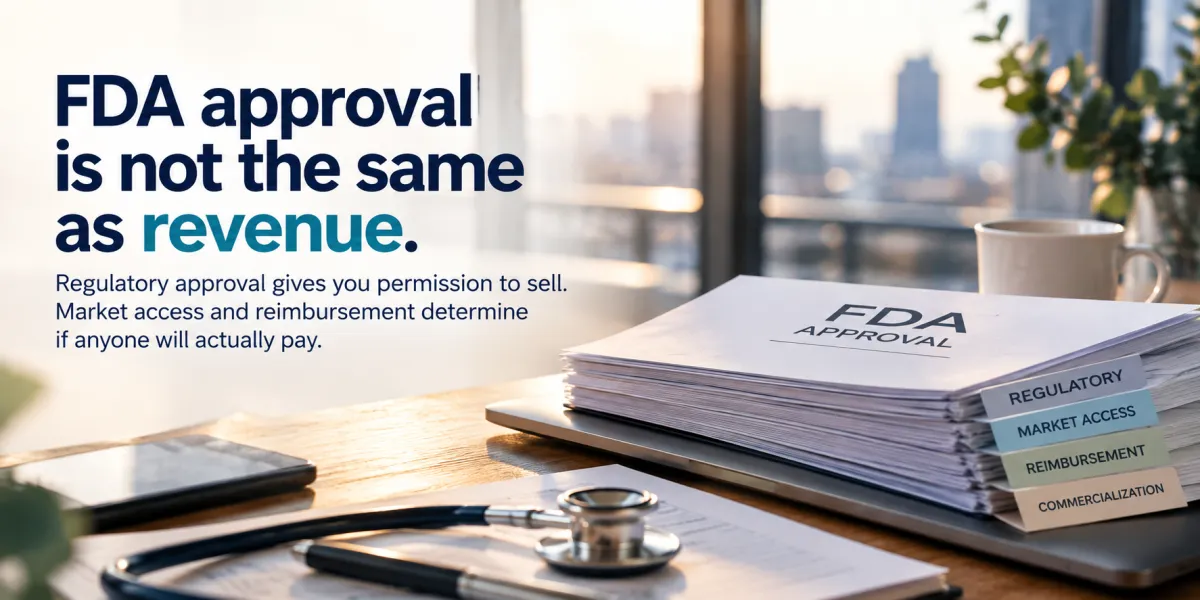
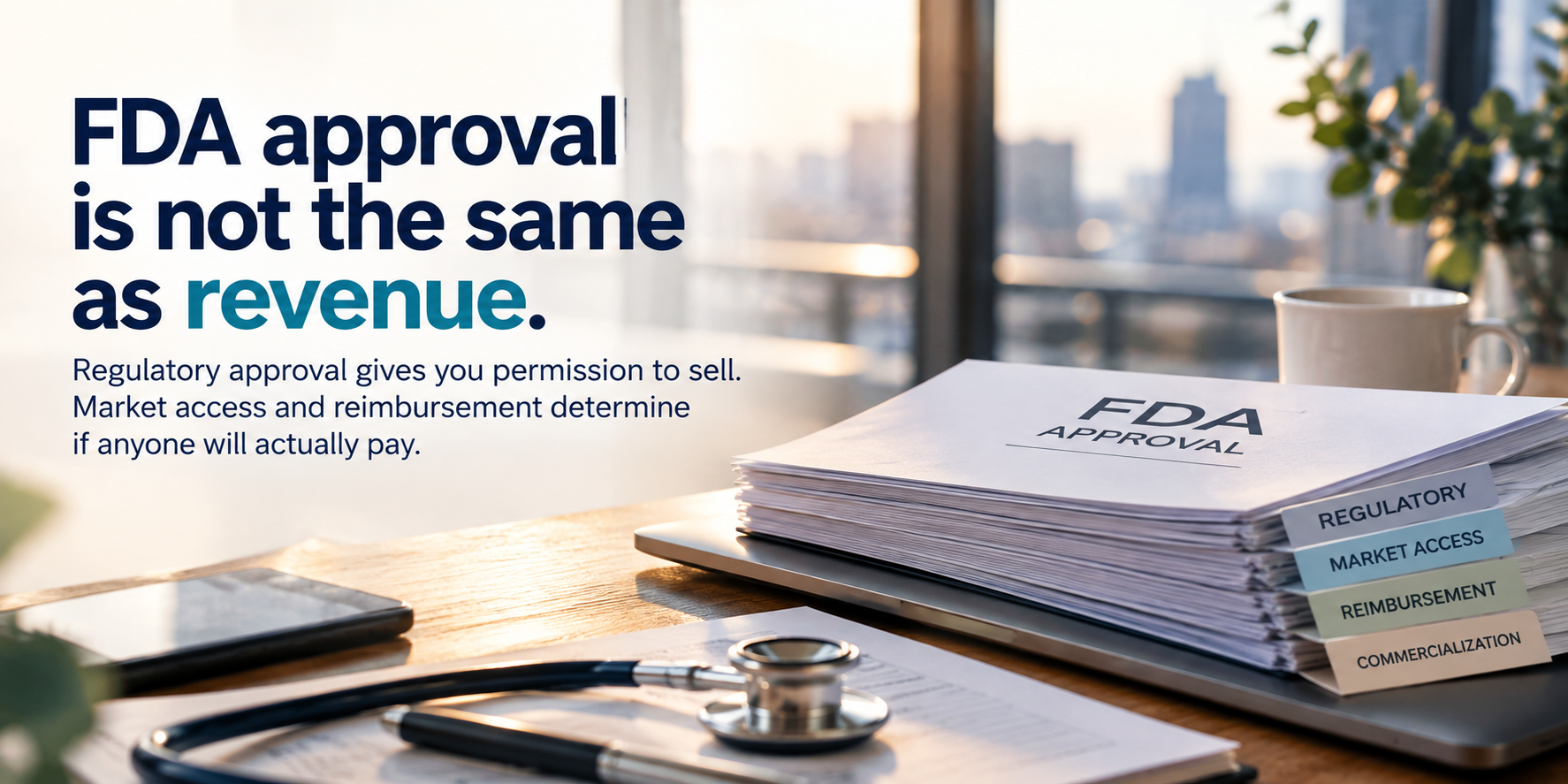
That experience reinforced something I see repeatedly in MedTech: regulatory approval gives you permission to enter a market. It does not create the mechanism through which that market pays you.
That mechanism - the MedTech market-access, reimbursement and commercialization model - needs to be designed much earlier.
What is MedTech market access?
MedTech market access is the practical path that allows an approved product to reach eligible patients or users and generate paid adoption. It connects regulatory approval with the economic buyer, reimbursement or budget pathway, evidence requirements, pricing, distribution and real-world adoption.
This is why a regulatory strategy and a commercialization strategy cannot be treated as the same plan. A product may be clinically valuable and legally marketable while the MedTech business model is still commercially incomplete.
FDA approval vs. reimbursement: two different questions
Regulatory approval answers whether a product can be marketed for its intended use. Reimbursement and market access answer whether a payer, provider, employer, patient or other economic buyer has a workable mechanism and sufficient reason to pay for it.
Regulatory approval | Market access & commercialization |
Can the product be marketed for its intended use? | Who pays, through which budget or reimbursement mechanism? |
Focuses on regulatory evidence and requirements | Adds economic, clinical, workflow and adoption evidence |
Regulator is a critical decision-maker | Payer, provider, employer, procurement, patient or another budget owner may decide |
Creates an important trust milestone | Must translate trust into a repeatable path to paid adoption |
Regulatory milestone | Revenue and business-model pathway |
The missing variable: payability
When founders forecast a MedTech market, they often start with market size, expected price and potential volume. I would add another variable: payability.
Revenue potential = Price × Volume × Payability
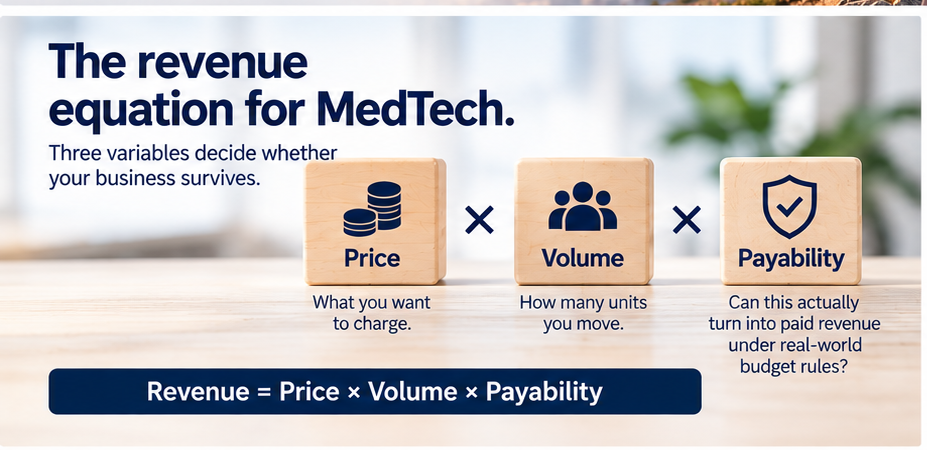
Payability is the degree to which real clinical use can convert into collected revenue under the actual rules of the payer, provider, patient and budget environment.
It forces a MedTech team to move beyond 'there is a need' or 'doctors like the product' and ask whether the business model can actually move money.
·Who is the economic buyer?
·Is payment self-pay, insurer reimbursement, a hospital budget, an employer contract, a public tender or another mechanism?
·If reimbursement is partial, who funds the remainder?
·What evidence unlocks payment - clinical outcomes, health-economic savings, workflow efficiency, patient engagement or another proof point?
·Does the payment level support the acquisition, implementation, service and support costs required by the model?
Four MedTech market-access and business-model patterns
There is no single MedTech reimbursement model. The right commercialization design depends on who receives the value, who controls the budget and what mechanism can convert that value into payment. The examples below show why 'market access' is a business-model question, not only a reimbursement question.
1. Consumer payment and employer-sponsored models
ŌURA demonstrates a consumer-led model: individuals can purchase the product directly, while eligible US buyers may also use HSA/FSA funds depending on their plan. The key commercial question is therefore different from a reimbursed medical device: is the perceived ongoing value strong enough for an individual to buy and remain engaged?
Hinge Health illustrates a B2B healthcare model. It sells musculoskeletal care solutions to employers and health plans, and emphasizes outcomes, savings, contracting and integration into the buyer's existing benefits ecosystem. Here, clinical value alone is not enough; the business case has to work for the organization funding access.
2. National reimbursement pathways
Germany's DiGA pathway shows what happens when a digital-health product can enter a defined statutory reimbursement route. HelloBetter states that its listed DiGA products can be prescribed and that statutory health insurers cover the cost. That creates a payment mechanism - but commercialization still requires adoption: clinicians need to prescribe, patients need to activate and use the product, and the company still needs an effective route into routine care.
The lesson: a reimbursement pathway can remove a major payment barrier, but it does not remove the need for go-to-market execution.
3. Coverage eligibility and channel design
Dexcom shows how coverage criteria can shape addressable demand. Its continuous glucose monitoring systems are covered by Medicare for beneficiaries who meet specified eligibility criteria, while commercial insurance coverage also varies. Expanding eligible populations can therefore materially change the commercial opportunity.
For other MedTech companies, channel design can be just as important as coverage. A product routed through a pharmacy, distributor, hospital procurement process or direct-to-consumer channel creates different friction, cash-flow dynamics and buyer behavior. The commercialization model has to account for that route - not merely the clinical indication.
4. Provider economics and procedure volume
Capital equipment creates another version of the problem. A hospital can believe in the clinical value of a technology and still decide not to buy it if the capital expenditure, training, workflow changes, utilization assumptions or procedure economics do not make sense.
This is why a MedTech business model should map not only the list price, but also the buyer's internal economics: implementation burden, capacity, reimbursement, utilization, staffing and the financial consequence of adoption.
The warning case: Pear Therapeutics
Pear Therapeutics is a useful reminder that regulatory authorization and commercialization are separate achievements. The company developed FDA-authorized prescription digital therapeutics and filed for Chapter 11 protection in April 2023.
Pear's own public filings had warned that coverage and reimbursement for prescription digital therapeutics were uncertain and that inadequate reimbursement could materially impair its ability to generate revenue. The lesson is not that reimbursement was the only factor behind the company's outcome. It is that regulatory authorization, prescriptions and clinical interest do not by themselves guarantee a scalable revenue model.
Commercialization fails when the path from clinical demand to collected revenue remains too uncertain, too fragmented or too expensive.
Why MedTech commercialization should start before approval
The commercial work should not wait for the regulatory milestone. The exact sequence will vary by product and market, but the regulatory plan and the market-access plan should inform each other early.

For a founder, that means validating several assumptions while regulatory work is still progressing:
·Economic buyer: Who controls the budget and who influences the decision?
·Payment pathway: What code, coverage policy, contract, tender, benefit or self-pay mechanism will be used?
·Evidence: What does the economic buyer need beyond regulatory evidence?
·Price and unit economics: Is the achievable payment level sufficient for the cost to acquire, onboard and support the customer?
·Adoption workflow: Who has to change behavior for the product to be used?
·Sales cycle: What committees, procurement steps, contracting requirements or payer decisions sit between interest and revenue?
·Fallback model: If reimbursement is partial, delayed or unavailable, is there a viable alternative buyer or funding mechanism?
Five questions every MedTech market forecast should answer
1. Who pays? Name the economic buyer, not only the clinician or patient who uses the product.
2. What unlocks payment? Identify the real mechanism: reimbursement code or policy, insurer contract, hospital budget, employer benefit, public tender, pharmacy benefit, self-pay or another route.
3. What proof matters? Regulatory evidence may not be the same evidence a payer or provider needs. Test whether the decision is driven by clinical outcomes, cost reduction, workflow improvement, capacity, patient adherence or another economic result.
4. When can revenue realistically start? Keep the regulatory timeline separate from the reimbursement, contracting and adoption timelines. Model the dependencies rather than assuming approval automatically starts revenue.
5. What can break the model? Look for partial coverage, low payment rates, budget caps, administrative burden, procurement delays, implementation costs, low utilization or a sales process that costs more than the resulting account is worth.
A practical MedTech business-model test
Before describing a market as attractive, I would map one complete payment journey from product use to cash collection.
Step | Question | What to validate |
1. User | Who uses the product? | Need, workflow, adoption friction |
2. Clinical influencer | Who recommends or prescribes it? | Trust, evidence, behavior change |
3. Economic buyer | Who owns the budget? | Budget authority and buying trigger |
4. Payment mechanism | How does money move? | Coverage, code, contract, tender or self-pay |
5. Economics | Does the payment support the model? | Price, margin, implementation and support cost |
6. Conversion | What turns interest into payment? | Procurement, claims, contracting and fulfillment |
7. Scale | Can this repeat predictably? | Sales cycle, channel capacity and unit economics |
Frequently asked questions about MedTech market access and reimbursement
Does FDA approval guarantee reimbursement?
No. FDA authorization or approval and reimbursement are separate. Coverage and payment depend on the payer, product category, indication, evidence, policy and commercial pathway.
What is the difference between MedTech market access and reimbursement?
Reimbursement is one mechanism through which a product may be paid for. Market access is broader: it includes the economic buyer, coverage or budget route, pricing, evidence, procurement, channel, adoption and the practical path to paid use.
When should a MedTech startup develop its reimbursement strategy?
As early as possible in commercial planning. The appropriate timing varies by product and geography, but teams should understand likely payer and evidence requirements before assuming regulatory approval will translate into revenue.
What is a MedTech business model?
A MedTech business model explains who receives value, who pays, what they pay for, how the product reaches the user, what evidence is required, what costs are involved and how the company can repeat that transaction profitably.
What if insurance covers only part of the product cost?
Then the company needs to understand who can legally and practically fund the remainder and whether that blended payment model is acceptable to patients, providers and payers. Partial reimbursement is not the same as a complete commercialization model.
Is market access only relevant to reimbursed medical devices?
No. Self-pay, employer-funded, hospital-budget, public-procurement and other models still require market-access thinking because someone must control a budget, perceive sufficient value and have a workable path to purchase.
From regulatory milestone to repeatable revenue
FDA approval, CE marking or another regulatory milestone can be transformative. It can increase trust, open doors and reduce an important source of uncertainty.
But it should not be mistaken for a MedTech go-to-market strategy.
The stronger question is not simply, 'Can we launch?' It is:
Can we build a repeatable path from clinical value to adoption to payment - with economics that work for the customer and for us?
That is where market access, reimbursement, commercialization and the MedTech business model meet.
If you are approaching regulatory approval, entering a new market or seeing strong clinical interest that is not yet converting into revenue, GTM Advantage can help you map the economic buyer, validate the commercial assumptions and build a practical go-to-market path.
Download: 10 MedTech Market Access Cases Here
The companion 12-page guide compares ten MedTech and digital-health companies across self-pay, employer, statutory reimbursement, payer coverage, provider economics and other market-access routes.
Need Help Mapping Your Path to Paid Adoption?
If you are approaching regulatory approval, expanding into new markets, or seeing strong clinical interest that isn't converting into revenue, don't wait for approval to figure out who pays.
Through GTM Advantage, Adrijana Daragon works directly with MedTech and HealthTech founders to:
Identify and validate your true economic buyers.
Map your exact reimbursement, coding, or contracting pathway.
Build a go-to-market strategy that converts clinical demand into predictable revenue.
[Book a GTM Priority Session with Adrijana]
Refrences
U.S. SEC - Pear Therapeutics Chapter 11 filing (primary source for the April 2023 bankruptcy filing).
HelloBetter - DiGA reimbursement information (official information on statutory health-insurance coverage).
Hinge Health - employer market-access model (official employer page covering contracting, ecosystem integration and savings proposition).
ŌURA - HSA/FSA purchase guidance (official eligibility and payment guidance).
Dexcom - Medicare coverage information (official CGM eligibility and coverage information).