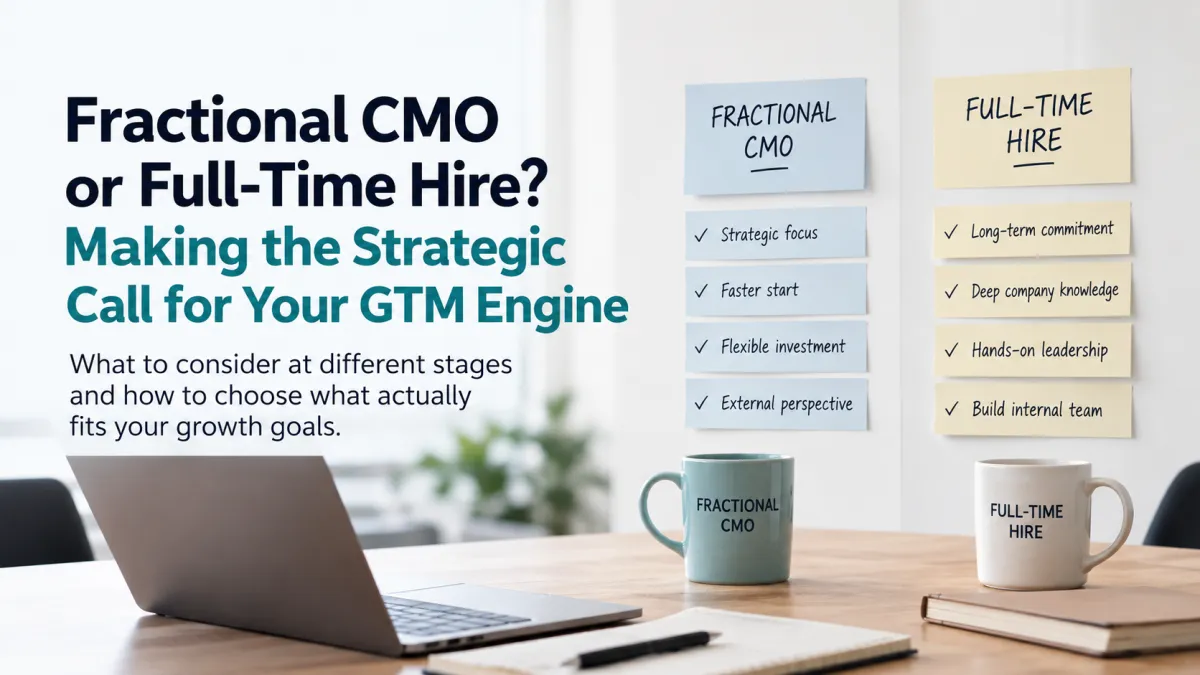
Fractional CMO or Full-Time Hire? Making the Strategic Call for Your GTM Engine
Most founders frame the commercial leadership decision as a budget question: "We can't afford a full-time CMO yet, so we'll go fractional."
But the real question has nothing to do with your bank account. It has everything to do with GTM maturity. When your leadership structure doesn’t match the maturity of your business, even the most talented hire will experience friction rather than acceleration.
The Real Risk: Mis-Timed Leadership
The biggest mistake scaling companies make is hiring too early. Many reach a stage where marketing feels inconsistent and pipeline fluctuates. The reflex is to hire a CMO. However, without a clear GTM architecture—defined ICP, sharp positioning, and aligned demand systems—even an experienced executive cannot produce results.
The 3 Stages of GTM Maturity
To know who to hire, you must first identify which stage you are in:
Stage 1: Founder-Led Growth: The founder drives sales. Messaging evolves through direct conversations. Speed matters more than structure.
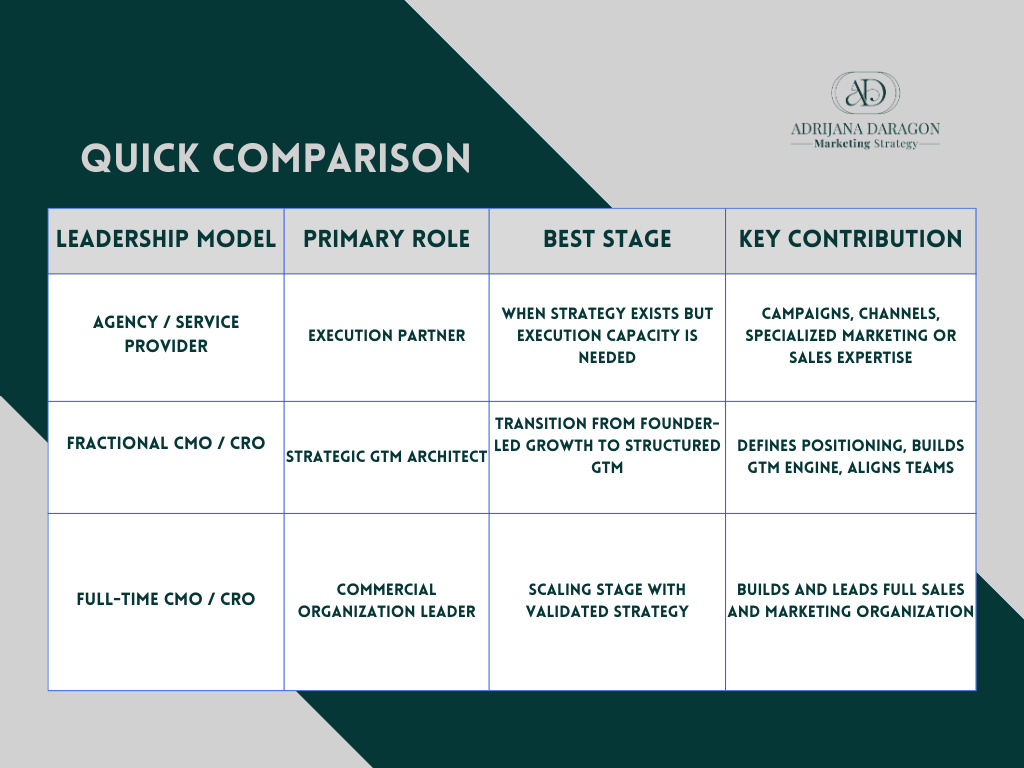
Stage 2: Structured GTM Engine: Growth requires coordination. You need a repeatable pipeline and visibility into revenue drivers. This is where a Fractional CMO is most valuable. They act as the architect to build the engine connecting positioning to revenue.
Stage 3: Scalable Commercial Organization: The engine works. Now you need a leader focused on building large teams and operational execution. This is the time for a Full-Time CMO.
A Diagnostic Checklist for Founders
Instead of asking "Should we hire a CMO?", ask: "What does our GTM system actually need right now?"
Do we have a clearly defined Ideal Customer Profile (ICP)?
Are marketing and sales aligned on positioning?
Is the founder still driving every key revenue decision?
If your answer to these is "Yes," you likely need GTM architecture, not just more execution.
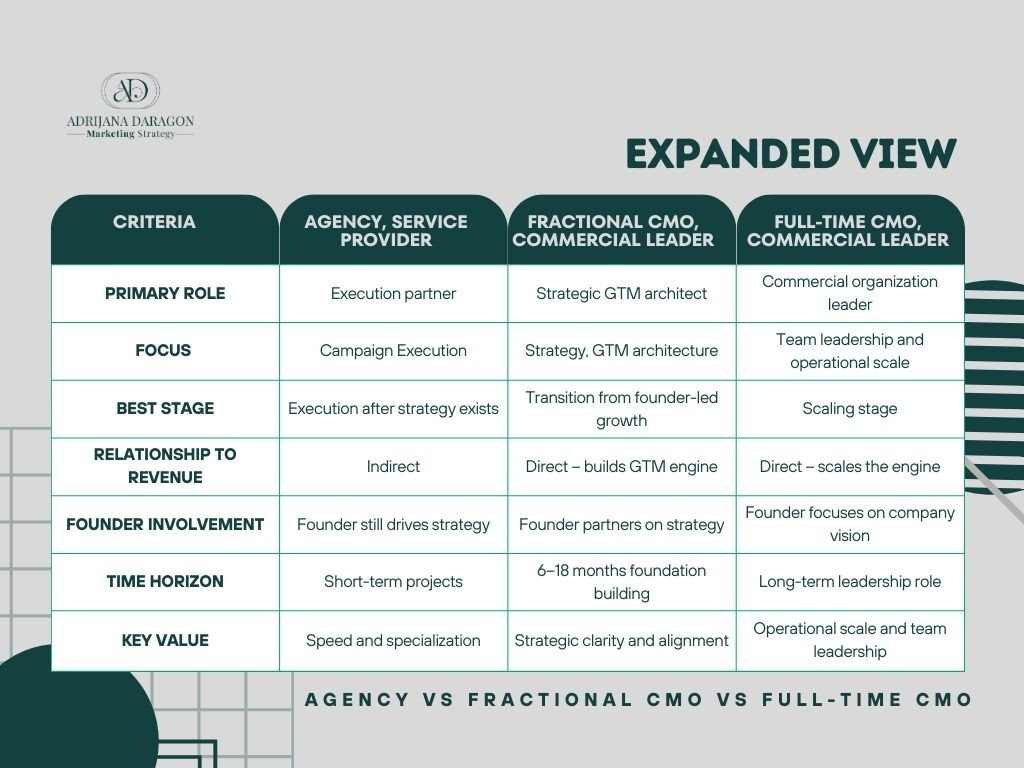
Final Perspective: Agencies execute campaigns, but someone still needs to design the engine. Once that system exists, scaling becomes easier—and the decision between fractional and full-time leadership becomes obvious.