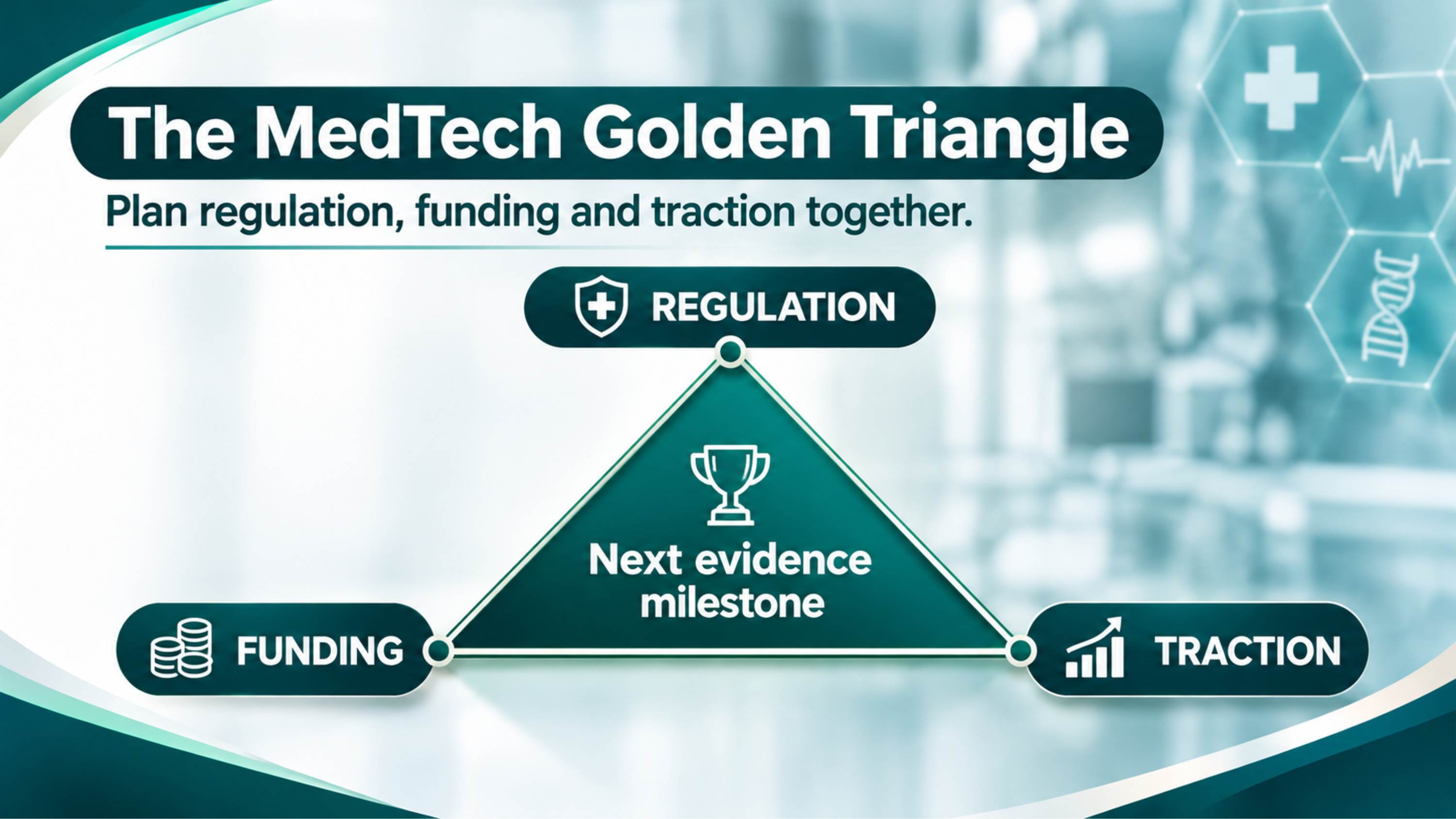
The MedTech Golden Triangle for go-to-market Strategy
By Adrijana Daragon, GTM Advantage
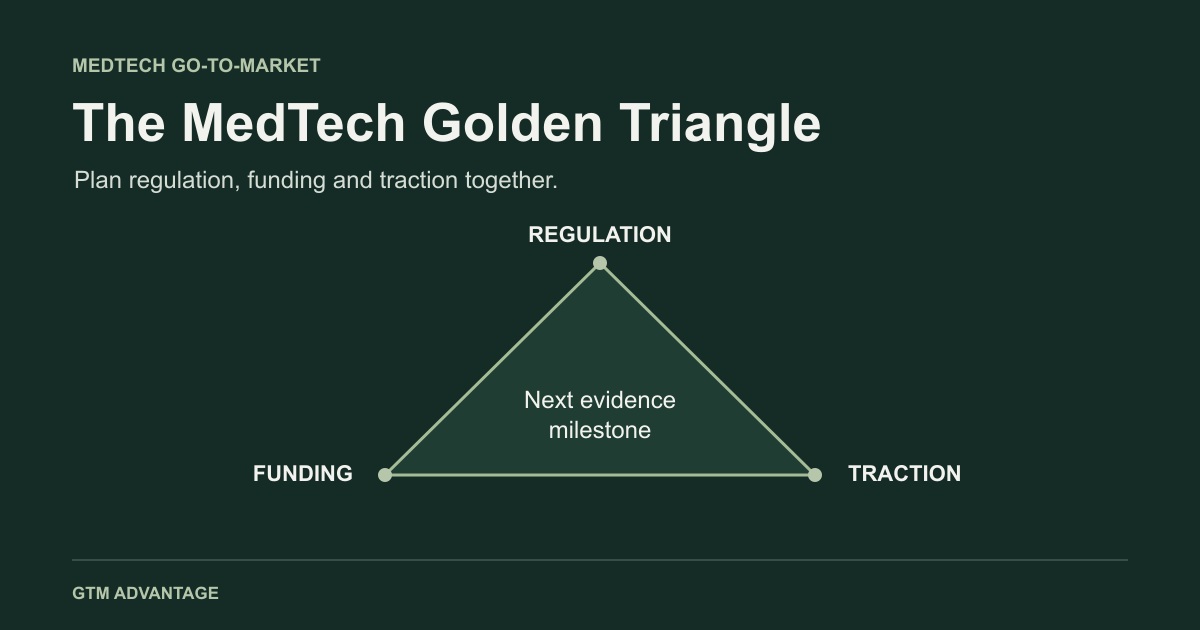
The MedTech Golden Triangle is a planning framework that connects regulation, funding and traction. Regulation defines the evidence needed to support a device’s intended use and claims. Funding pays for milestones that reduce risk. Traction shows whether a defined customer group will invest time, resources or budget in adopting the device. Planning them together helps founders choose what to validate before they commit to the next expensive milestone.
Last week I spoke with a MedTech founder whose plan put regulatory work first, fundraising second and commercial traction third. They had encouraging feedback from clinicians. It made me think about what a team can learn about adoption while the other work is still underway.
What a Urology Endoscope Example Teaches About Customer Validation
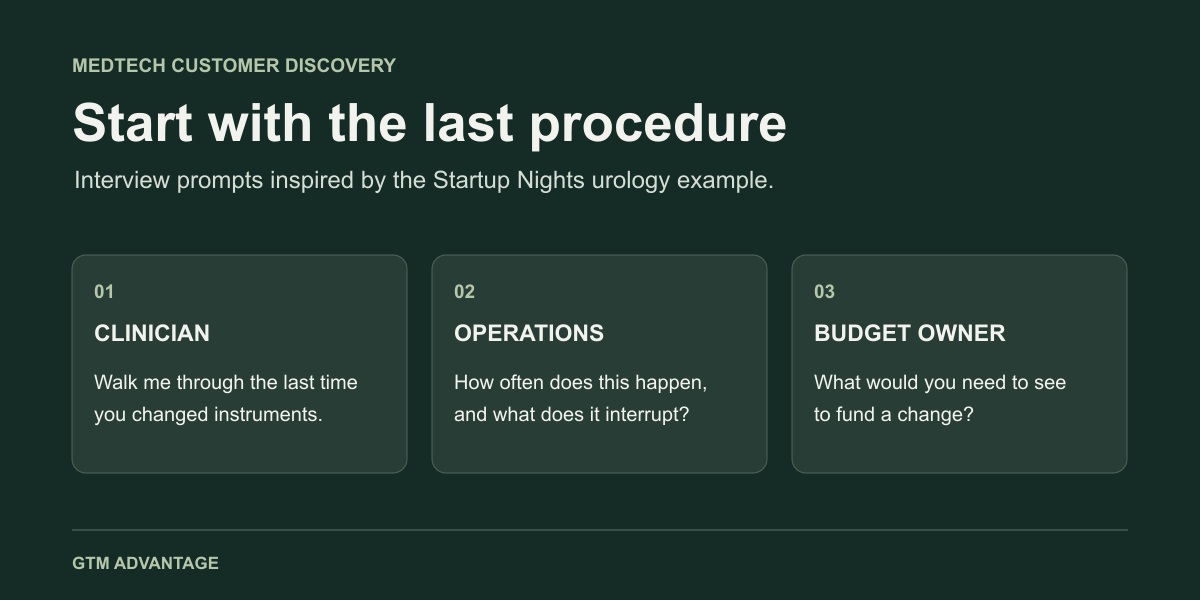
At Startup Nights 2026 in Winterthur, Jens Haarmann of ZHAW and Lukas Jaeger of University Hospital Zurich led a HealthTech startup workshop. A urology example explored whether a wider field of view could reduce instrument changes during procedures. Startup Nights programme
The workshop recap describes four possible sources of value. The figures below were recorded in the earlier recap as slide findings for that specific example. The original slide and its underlying methods were unavailable for verification. Treat the figures as illustrative case notes, with no inference to other procedures or devices.
Potential problem | What the recap recorded | Commercial question to test |
Extra procedure time | Instrument changes reportedly affected 0–5% of procedures and added under two minutes in the example. | Which procedures account for the delay, and what does it interrupt? |
Infection concerns | The recap records a figure below 1%, with the exact denominator and measure unconfirmed. | What outcome and comparison would clinical stakeholders need before considering a safety claim? |
Preparing multiple endoscopes | Preparation came up as a potential workflow burden. | Who prepares each instrument, and where does the work fall in the schedule? |
Equipment cost | Equipment economics were identified as a possible source of value. | Which costs would actually change, and whose budget would reflect them? |
The commercial issue is whether a meaningful benefit survives scrutiny in a specific hospital workflow. A preparation burden can matter to the people doing the work, yet yield little spend reduction. A small saving per affected case can also matter in a particular setting if the affected cases cluster around a bottleneck. Find that setting and check the assumptions with the people who run it.
What to ask clinicians, operations teams and buyers
These questions are reconstructed for founder use and are separate from the workshop slide content.
1. Clinician: Walk me through the last case when you changed instruments. What triggered the change, and what happened next?
2. Operating-room or preparation lead: Over a typical week, how often does this happen? How could we check that estimate with records you can share appropriately?
3. Clinical or operational champion: Which consequence matters most, and what do you already do to manage it? Under what circumstances would changing the workflow be worth the effort?
4. Budget owner: Where would the cost or benefit appear in your budget? What would we need to measure for it to matter in a purchase decision?
5. Procurement or approval stakeholder: Who participates in an evaluation, which evidence do they require, and what is the next step you could actually take?
Capture the institution type, use case, current alternative, evidence source and remaining uncertainty for each answer. Compare observations across independent sites where possible. A clinician’s willingness to introduce you to a budget owner gives you a more concrete next step than positive feedback alone.
Turn the three sides into one evidence plan
Regulation. Start with the proposed intended use, target market and claims. Work with qualified regulatory support to establish the applicable pathway and evidence needs. A narrower use case may change the evidence plan, so bring commercial findings into those discussions early. Keep exploratory workflow observations separate from evidence used to substantiate clinical claims.
Funding. Define what the next round of work will establish. Tie the budget to an observable milestone, such as completing a defined evidence package or clarifying the conditions under which target hospitals would evaluate the device. Record who owns it, what it costs, how long it could take and what the team will do if it comes back inconclusive.
Traction. Track what stakeholders do. An introduction to procurement, time committed to an evaluation design and an approved budget each tell you something different. Keep expressions of interest, permitted evaluation commitments and purchases separate in the pipeline. For any device evaluation, check the applicable regulatory, ethical and institutional requirements before proceeding.
A decision to make at your next team meeting
Choose one specific hospital segment and one use case. In a single page, record the intended benefit, what evidence would support it, who would act on that evidence, and what you can afford to spend to find out.
For example, a team investigating preparation time might start by documenting the current workflow with staff at suitable sites. Before interpreting time saved as a financial benefit, the team would check whether the budget owner values that saving and whether it changes staffing, throughput or equipment purchasing. If the benefit appears concentrated in a narrower segment, the team can revisit its market assumptions and next evidence milestone before spending further.
Bring that page to the next funding or product review. Ask what finding would cause you to continue, narrow the use case or stop. Agree on the threshold before gathering the evidence, so positive feedback cannot quietly substitute for the result you needed.
Frequently asked questions
What is the MedTech Golden Triangle?
It is GTM Advantage’s planning framework for connecting regulation, funding and traction. Teams use it to decide which evidence to collect, what milestones to finance and what customer commitments to look for.
Can MedTech startups test demand before regulatory clearance?
Founders can explore workflows, unmet needs and purchasing processes through discovery conversations. Any promotion, device use or evaluation must follow the requirements applicable to the device, activity and jurisdiction.
What counts as early commercial traction in MedTech?
Concrete signals include an introduction to the budget owner, stakeholder time committed to evaluation planning or a documented procurement step. Track these separately from orders, revenue and repeat adoption.
Who should a MedTech founder interview at a hospital?
Interview clinicians who use the device, operational teams who support the workflow, and the people involved in budgeting and procurement. The right mix depends on the use case and how the institution makes purchasing decisions.
Building toward your first MedTech customers?
Join the GTM Advantage WaitList for updates on the support we’re developing for MedTech founders working on customer validation and go-to-market strategy. Tell us what you’re building and which commercial decision you need to make next.
Learn more about GTM Advantage’s go-to-market support for B2B technology companies.