
How to Build a B2B Startup Marketing Team That Actually Drives Growth
How to Build a B2B Startup Marketing Team That Actually Drives Growth
Why talented specialists, busy content calendars and AI productivity do not automatically translate into commercial progress
By Adrijana Daragon|GTM Advantage
A founder can have an internal marketing team, a group of talented freelancers, a new website in development and an impressive list of campaigns in motion, yet still feel that marketing is holding the business back. I have walked into that situation. It is tempting to diagnose it as a talent problem, a capacity problem or a need for better tools. But the underlying issue is often more fundamental: the people are delivering their individual assignments without a sufficiently clear, shared commercial purpose.
That distinction matters especially for founder-led B2B technology companies. When growth is still closely tied to the founder’s relationships, product knowledge and judgment, the marketing function cannot afford to become a production department that simply turns out more assets. Its role is to understand customers, make the company relevant to the right buyers, support commercial conversations and create a repeatable way of learning what works. Before deciding which specialist to hire next, founders need to decide what their marketing organization is actually accountable for.
What seven years at Procter & Gamble taught me about shared commercial ownership
Over seven years at Procter & Gamble, I worked across multiple teams, including regional and global environments. The marketing structures were not identical, but one principle stayed with me: specialist functions were expected to contribute to a shared brand and commercial plan. Brand management had a broad remit, spanning the product, innovation, launches and business priorities. Digital, research, communications and trade marketing contributed specialist expertise. Their work mattered not because a particular channel or deliverable existed, but because it supported what the brand was trying to accomplish in the market.

One memory is particularly vivid. I spent around six months preparing for a new product launch and its pre-launch activities, culminating in a presentation at a global distributor conference in Poland with approximately 300 attendees. Preparing that presentation was not simply a matter of making attractive slides. It meant bringing together the product story, the services, the commercial proposition and the details that would matter to distributors. Different specialists had their own responsibilities, but we were working towards a common moment in the market. The presentation was the visible result of months of coordinated work, not the objective in isolation.
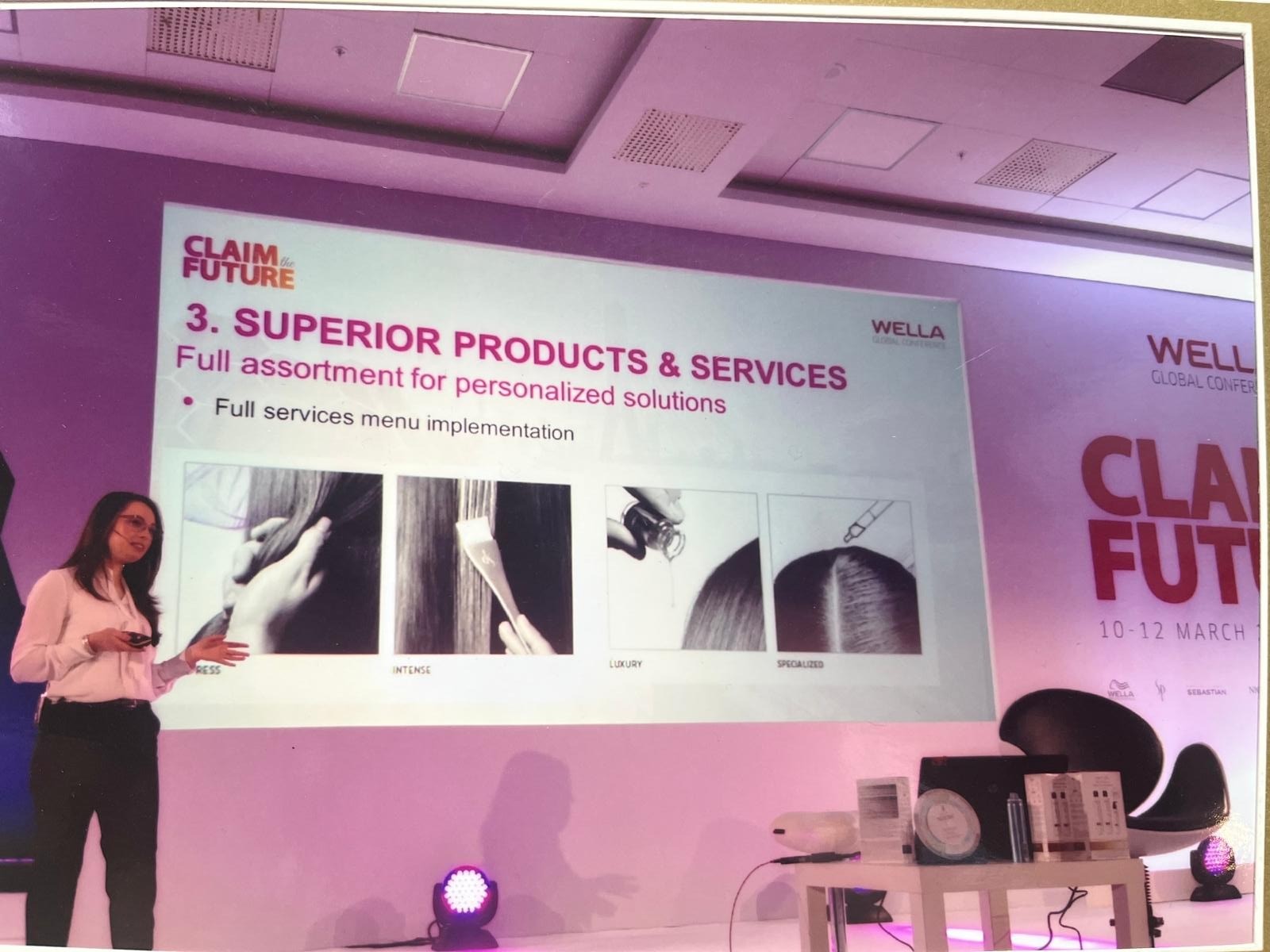
Archive photograph: Adrijana presenting at a distributor conference in Poland.
I am not arguing that a startup should copy a multinational consumer-goods organization chart. Big companies can be slower, more hierarchical and more complex than a young technology business can afford. But specialization and commercial accountability are not opposites. That is the lesson I would preserve: the team can contain different disciplines without losing sight of the business result they are collectively trying to create.
How startups end up hiring channels instead of building a marketing organization
A founder typically starts by solving the most visible problem. The website needs work, so they bring in a developer or designer. LinkedIn activity is inconsistent, so they engage a content creator. Organic visibility is weak, so they hire an SEO expert. They add a video editor to make the product easier to explain and a marketing automation freelancer to improve follow-up. Each decision can be sensible on its own. The problem emerges when the founder has assembled several specialists but nobody owns the connections between their work, the customer journey and the company’s growth priorities.

The designer can be judged on aesthetics, the SEO expert on rankings, the content creator on engagement and the automation specialist on the completion of workflows. Those measures are useful for managing the work, but they are not a substitute for knowing whether the work is helping the company reach the right customers, build credibility and move opportunities forward. In complex B2B markets, a beautifully produced campaign can be commercially irrelevant if it addresses the wrong buying concern. A website can launch on schedule and still fail to answer the questions that buyers and sales teams need it to answer.
This is why I resist the simplistic choice between a marketing generalist and a specialist. The more important questions are: Which commercial problem are we trying to solve? Which capability is missing? And who is accountable for coordinating the work around that problem? The right answer may be a hands-on GTM leader, a product marketer, a demand-generation specialist or a focused freelance project. It is rarely possible to decide from job titles alone.
The leadership change: from show-and-tell to customer intelligence
When I stepped in to lead marketing for a B2B technology company, there were already internal team members and external freelancers working across different assignments. Website milestones, creative deliverables and campaigns were progressing. The team was also enthusiastic about AI tools and the possibilities for faster production. Yet the CEO was concerned that marketing was slowing growth rather than enabling it. The team’s discussions gave a clue as to why: a lot of energy was going into what had been produced, which tool had been tried and how creative an asset looked, while too little attention was going into business development priorities, customer understanding and competitive intelligence.

My first intervention was not to ask everyone to produce more, or to replace the people who were already there. We changed the weekly synchronization and, more importantly, what counted as a useful discussion of progress. Instead of a predominantly project-by-project show-and-tell, the team began connecting its work to market developments, customer needs, competitors and the practical questions coming from commercial activity. Individual check-ins and team meetings became a place to share intelligence, test assumptions and decide what deserved attention next. A website milestone still mattered, but we also asked what buyer problem the page was supposed to solve and what evidence would tell us whether it had helped.
There was a genuine cultural dimension to this change. Graphic designers and copywriters are not always close to sales conversations, and a stronger emphasis on commercial priorities can sound like a threat to creative freedom. Would the work become mechanical? Would everyone be reduced to templates and dashboards? Would AI take over the interesting part? Those concerns deserve respect. Creativity and an authentic voice matter, particularly when so much generic content can now be generated quickly. But I wanted the team to see that better market intelligence is not a restriction on creativity; it is material that makes creativity more relevant.
That realization was the most meaningful outcome I observed. The team began to see that sharing customer insights and competitive information in individual and group discussions gave them better raw material for their ideas. It helped specialists make more informed creative choices rather than simply asking them to be less creative. This was a change in understanding and ways of working. I would not claim that it directly produced a specific revenue uplift without data to support that claim, but it created a more commercially grounded basis for marketing execution.
The five capabilities to build before you build departments
I use five connected capabilities to help founders think about marketing organization design. They are not five separate job titles, and an early-stage company does not need five full-time employees. They are five kinds of work that need ownership, whether through a founder, a marketing leader, a hands-on generalist or specialist partners.
1. Understand the market
Marketing needs to know which customers matter, how they buy, what creates urgency and how competitors are shaping expectations. Customer interviews, segmentation, buying-trigger research, competitive intelligence and feedback from sales all belong here. The test is whether the team can make better choices about whom to pursue and what matters to those buyers.
2. Position the offer and establish credibility
A technical product needs a commercially compelling story. Positioning, product marketing, messaging, proof points, case studies and sales materials should help buyers understand the value, urgency and differentiation. In complex B2B markets, that includes addressing the needs of multiple stakeholders, not just making the product sound innovative.
3. Create and capture demand
Only once the audience and proposition are sufficiently clear should the team choose its distribution mix. Thought leadership, search, targeted outreach support, events, partnerships and campaigns are routes to buyers, not objectives in themselves. Their relevance depends on deal size, buyer concentration and how purchasing decisions actually happen.
4. Help buyers convert and customers expand
Marketing should contribute beyond the first click or form submission. Buyer education, conversion paths, lifecycle communications, customer evidence and sales enablement can help opportunities progress. Depending on the business model, customer adoption, expansion and advocacy may also sit partly within marketing’s remit.
5. Operate, measure and learn
Someone must connect priorities, people, data, tools and decisions. Marketing operations includes reporting, automation, project coordination and a regular learning rhythm. The goal is not more dashboards or more meetings; it is to make it easier for the team to learn from customer evidence and improve what it does.
A founder’s hiring decision: choose the bottleneck, not the channel
A company whose prospects do not understand the product may need positioning and product marketing before it needs more traffic. A company with clear messaging and strong conversion but too few relevant opportunities may need demand creation. A company with a full roster of freelancers but fragmented priorities may need an experienced marketing builder who can establish ownership and an operating rhythm. A company whose marketing attracts interest but fails to support complex buying decisions may need better buyer enablement and lifecycle work. The hire follows the constraint, not the trend.
Observed bottleneck | Capability to prioritize |
Unclear buyer value or differentiation | Positioning and product marketing |
Too few relevant buyers reached | Demand creation and distribution |
Interest without commercial progression | Conversion and sales enablement |
Many specialists, no shared priorities | GTM leadership and marketing operations |
Clear strategy, insufficient output capacity | Targeted specialist execution |
The implication is practical. You do not necessarily need a full-time senior marketing executive from day one, but you do need somebody capable of making cross-functional decisions. A junior generalist cannot automatically compensate for a missing strategy, and a collection of specialist freelancers cannot independently establish commercial accountability. The founder may own that responsibility at first; as the business grows, it can be delegated to an experienced hands-on leader.
A five-step operating model: Diagnose, Own, Enable, Learn, Scale
Diagnose the constraint before changing the team. Review the customer journey and identify whether the main issue is market understanding, positioning, demand, conversion or execution. Then assign ownership: one person must connect the marketing plan to business priorities and be able to explain why each significant investment matters. Enable the specialists with customer conversations, competitive insight and clear briefs, rather than expecting every designer or writer to discover the commercial context alone.
Build a weekly learning rhythm. A useful team meeting should ask what we learned about customers, what changed in the market, which assumptions were tested, where commercial progress is blocked and what we will improve or stop. Project status still belongs in the operating system, but it should not crowd out the conversation about outcomes. Finally, scale the capabilities that show value. Add channel specialists and production capacity when the strategy, priorities and evidence justify the investment.
What should the team measure?
The measurement system should distinguish deliverables from customer progress and commercial outcomes. A launched website, a published article and a completed automation are outputs. Engagement from relevant buying accounts, more informed sales conversations and improved qualified conversion are closer to customer outcomes. Pipeline, customer acquisition, retention and expansion are business outcomes, although marketing rarely controls them alone. The right measures depend on the business model and sales cycle; in enterprise B2B, judging a new initiative only on immediate revenue would be misleading.
The important shift is not to demand a revenue number from every designer or copywriter. It is to make sure each specialist understands the purpose of the work, the intended audience response and what the team can learn from it. This allows the organization to celebrate creative quality while still evaluating whether its investment is commercially useful.
AI can accelerate marketing activity. It cannot replace the shared purpose.
AI makes this organizational question more urgent. Teams can now research accounts, generate drafts, create variations and automate repetitive tasks faster than before. Used well, these tools free experienced people to spend more time understanding buyers, developing ideas and making judgments. Used without a common strategy, they simply accelerate fragmented production. A show-and-tell of clever AI tools can be energizing, but it should not displace the harder questions about customers, competition and growth.
My experience with the startup team reinforced that point. The answer was not to suppress experimentation or authentic creative voices. It was to reconnect experimentation to customer intelligence and commercial learning. A better-informed creative team is not a less creative team. It has more meaningful problems to solve.
The marketing organization founders should actually build
When I look back at six months of launch preparation and that distributor conference in Poland, I do not remember an organization in which everybody had identical skills. I remember different specialists contributing to a shared commercial objective. When I look at the founder-led companies I advise today, the same principle applies, even if the team consists of one internal marketer and a handful of freelancers. The organization does not become effective because everybody is busy, the visuals are beautiful or the AI workflow is impressive. It becomes effective when customer understanding informs priorities, specialists work together and the team can explain what it is learning about growth.
Before hiring another marketer, ask a more useful question than “Which channel do we need?” Ask: “Which capability is preventing us from making commercial progress, and who will bring the team together to solve it?” That is where building a marketing organization begins.