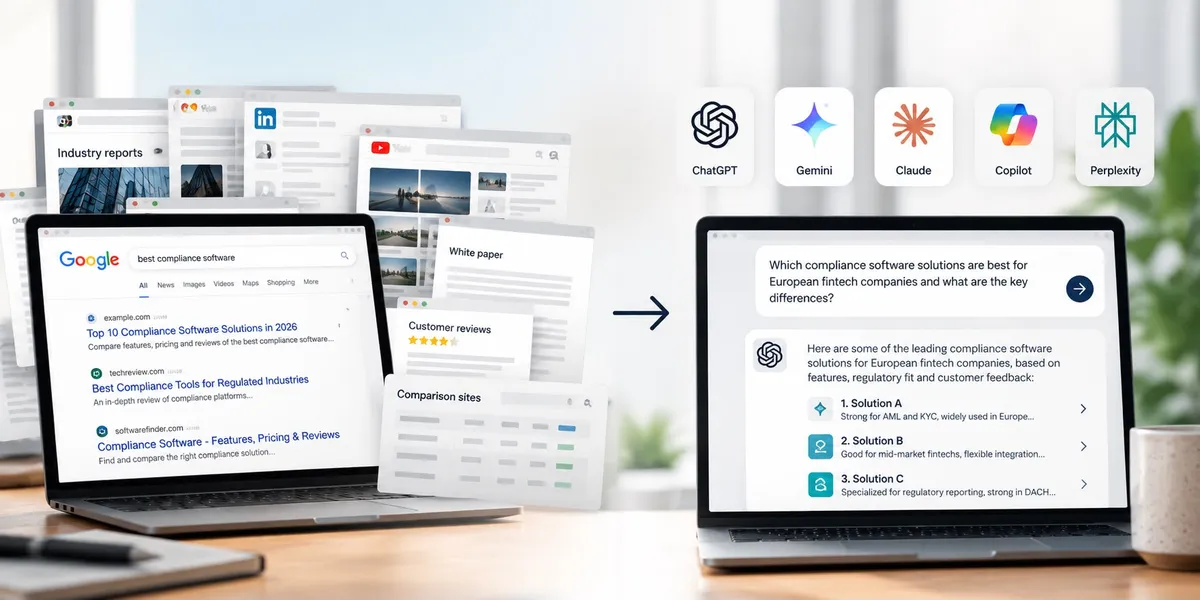
Your Next B2B Customer May Never Visit Your Website. Will AI Still Recommend You?
What if your next customer never discovers your company, not because your technology is weak, but because an AI assistant never puts you on the shortlist?
And what if AI does recommend you, but you still have not decided which customers you should sell to, what they need to believe, or what would make them buy?
These questions stayed with me after Bits & Pretzels in Munich. Hubertus Bessau of EWOR posed a challenge in his session on branding when the buyer might be a machine: MAKE IT RETRIEVABLE. Not merely visible.
But the conversations I had with founders in AI, healthcare, deep tech, energy and fintech revealed another part of the problem. Discoverability is only valuable when it is connected to a market worth serving and a buying decision a company understands.
My view after 20 years in B2B marketing: AI can accelerate the path to market. It cannot substitute for deciding which market, which customer problem, and which evidence deserve that investment.
1 | Buyers may shortlist you before they visit you
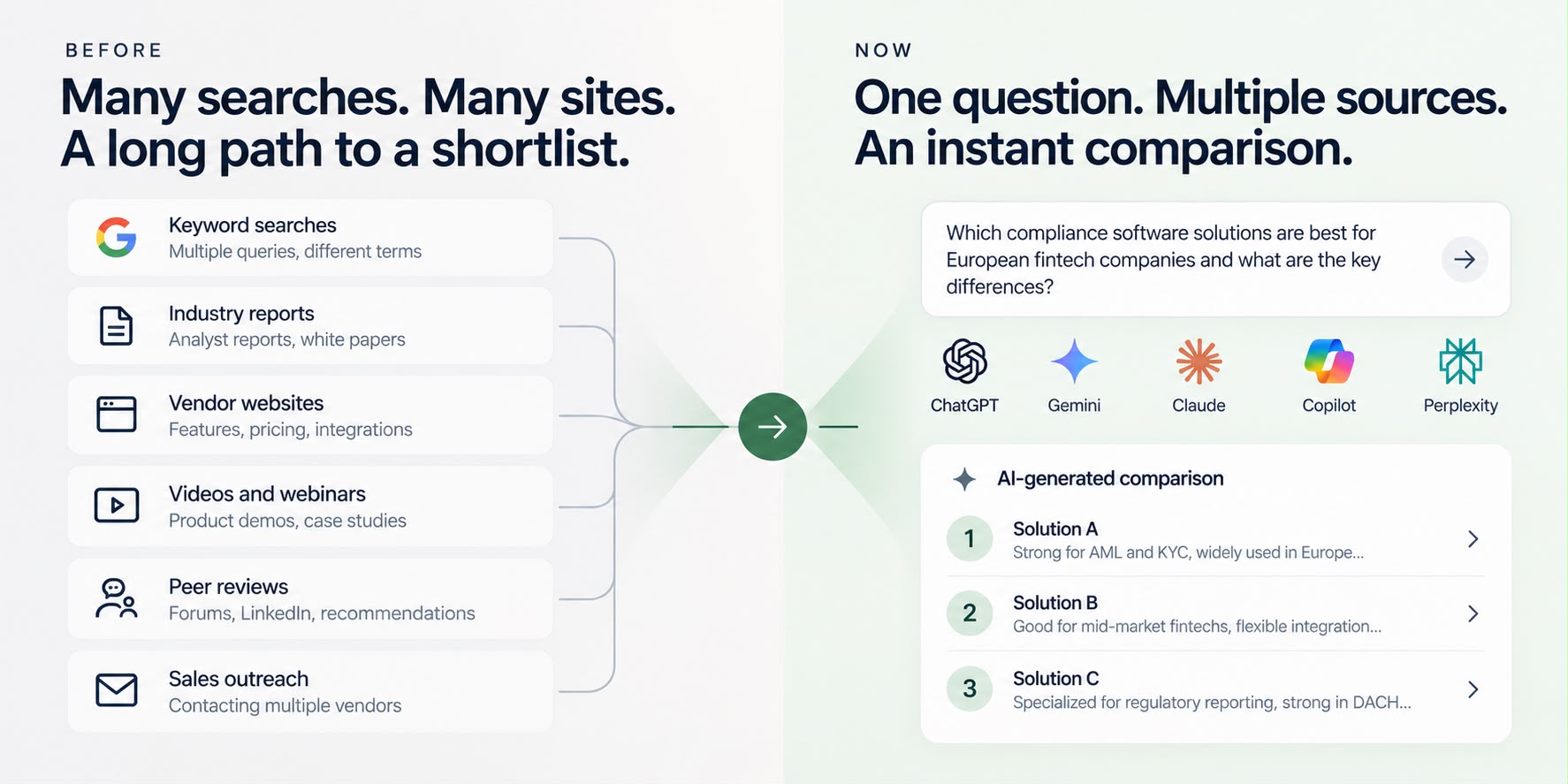
A buyer can now ask an AI assistant to compare suppliers, review requirements and summarize evidence before visiting a vendor website. Imagine a compliance leader asking: “Which European AI vendors can identify documentation gaps before an audit while preserving traceability and human oversight?” That is not a simple keyword query. It is a buying situation.
Gartner reported in May 2026 that 45% of surveyed B2B buyers had used generative AI during a recent purchase, and that 69% preferred validating AI-generated insights with sales representatives. Different studies use different samples and definitions; they should not be combined into a single adoption estimate. The direction is clear: AI is becoming part of research, while human validation remains important.
The risk is not that sales teams disappear. It is that some vendors may never make the initial consideration set.
2 | What “make it retrievable” really means
Bessau distinguished between what a company shows, what others say about it, and what customers actually experience. A machine does not have a customer’s lived experience. It retrieves accessible information and evidence about that experience.
A polished website and claims of innovation are not enough. A customer explaining a verified outcome, a clear technical specification, a partner reference, or a transparent benchmark can give buyers and AI systems more useful information.
Publish clear product capabilities, relevant use cases and honest limitations.
Make independent customer and partner evidence accessible; do not confuse purchased mentions with earned trust.
Explain measurements: baseline, time period, method and constraints.
Ensure critical content is crawlable and understandable; maintain foundational SEO.
Say whom you are not for, so relevance is easier to assess.
Your website remains an important source of truth. Third-party evidence helps corroborate it. The goal is not to game an AI model, but to make genuine expertise verifiable.
3 | Name the moment, not only the market
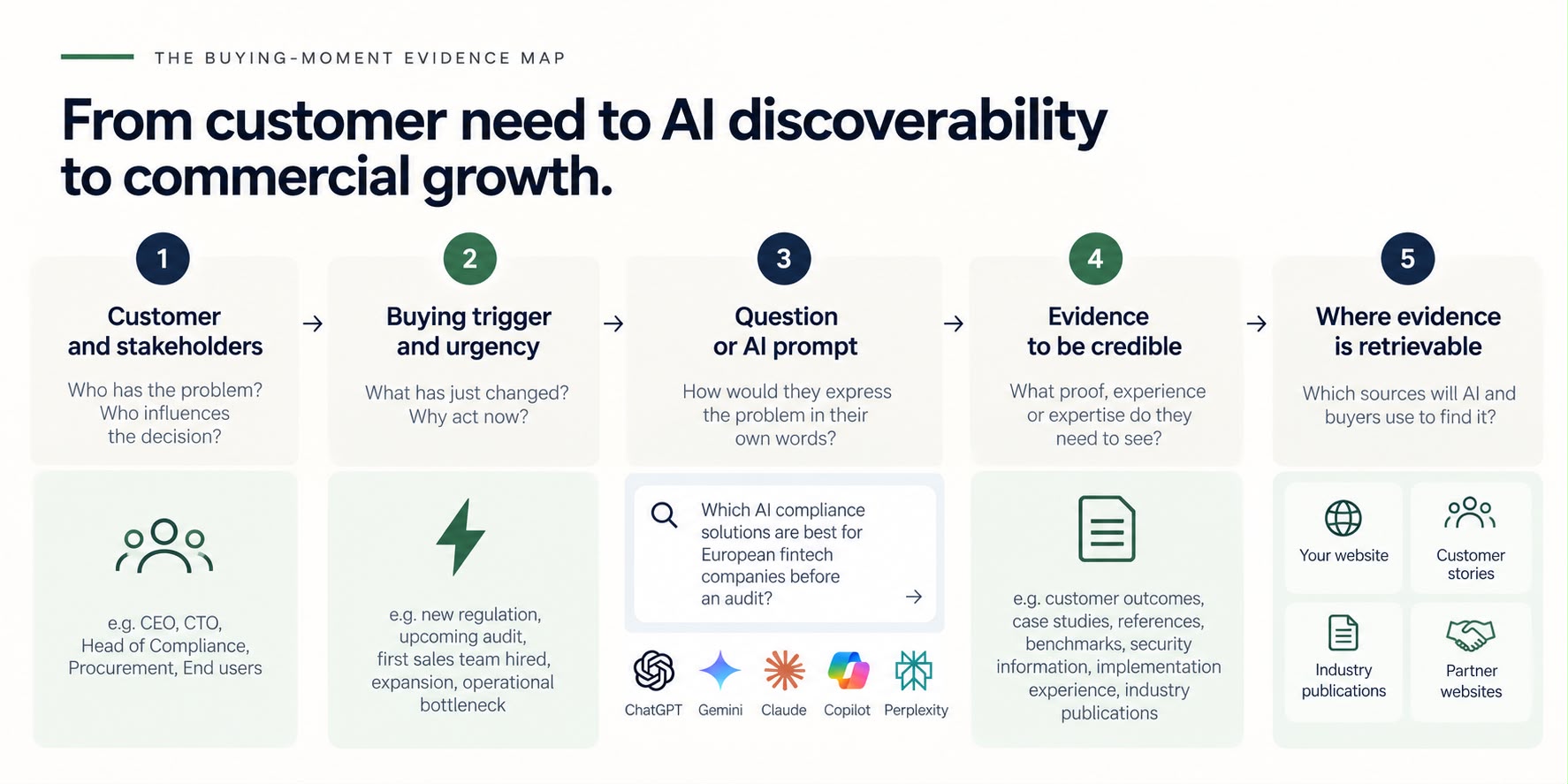
“Mid-market fintech in Europe” describes a market. “Our audit is in three weeks and the current process may fail” describes a moment. The second statement contains urgency, risk and a reason to seek help—and sounds like something a buyer might ask an AI assistant.
Traditional ICP work needs an additional layer: the event that triggers a buying decision, the question the buyer asks, the evidence needed to answer it and the sources where that evidence can be found.
A deep-tech founder: the next market is also a product decision
At Bits & Pretzels I met a seed-funded healthcare deep-tech founder with a POC at a major pharmaceutical company. The founder saw a real opportunity in a specialized cancer application, but also the possibility of expanding synthetic-data technology into larger adjacent markets. That would require more product development and different proof.
The question was not “Is our technology any good?” It was: should GTM begin now, or only once the next product is ready? My takeaway: market conversations before launch can clarify what the next product needs to prove. Creating content for every imaginable use case is not the same as validating which use case deserves investment.
A fintech scale-up: visibility was not the bottleneck
Another founder described a consumer fintech with more than 500,000 users and strong referral growth. But monetization depended materially on bank partnerships; one relationship had taken about a year from initial discussion to contract. The consumer acquisition engine and institutional partnership engine were not the same.
More AI-search visibility among consumers would not necessarily shorten bank decision cycles. The important unanswered questions were who decides, who blocks, what evidence each stakeholder requires and whether the partnership process can become repeatable. Those are GTM questions before they are content questions.
An AI governance founder: access is not market validation
An early-stage AI governance company was considering SME consultancies partly because the founders could reach them. But a reachable segment is not automatically the best commercial segment. A regulated product may need different workflows, integrations and compliance knowledge in each industry.
Choosing the first accessible customer as the ICP can pull a product toward a market that cannot support the company’s ambitions. AI can accelerate outreach into that market—but speed does not correct the underlying decision.
All founder examples are anonymized; strategic questions are described as discussed, not as verified subsequent outcomes.
4 | The GTM Advantage Buying-Moment Evidence Map
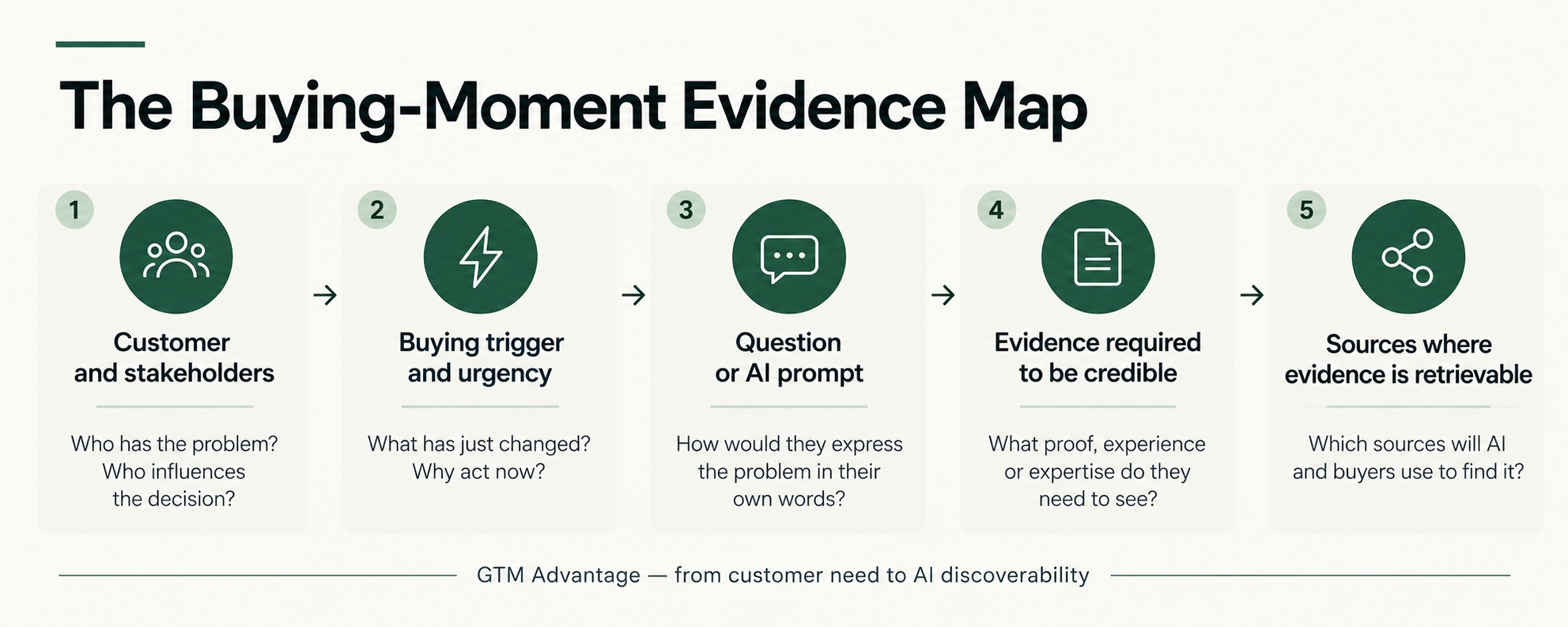
This is the practical framework I would use to connect AI discovery to actual commercial opportunities:
Stage | Question to answer | Illustrative output |
1.Customer | Who has the problem and who participates in the decision? | Stakeholder map |
2. Trigger | What has changed and why act now? | Urgent buying situation |
3. Question | What would the buyer ask a colleague or AI assistant? | Natural-language prompts |
4. Evidence | What proof would justify consideration? | Customer results, validation, limits |
5. Retrieval | Where can that evidence be found and checked? | Accessible owned and third-party sources |
Start with the situation, not with a hundred AI-optimized pages. The objective is not to appear everywhere; it is to be a credible answer when a valuable customer problem arises.
5 | Brand becomes harder to fake where customer experience is real
One of Bessau’s memorable lines was: “What you show gets cheaper. What people experienced gets scarcer.” AI can help recreate websites, content and some product features. It cannot instantly recreate years of implementation experience or trusted customer relationships.
For B2B buyers, trust is often a question of risk: will the solution work in our environment, who is accountable, can the supplier support us, and can we substantiate the promised outcome? Customer success creates the underlying evidence; marketing makes it understandable and retrievable.
A pilot proving technical feasibility does not automatically establish willingness to pay. An LOI does not automatically prove a repeatable market. A recognizable logo does not necessarily prove a scalable commercial model. Honest distinctions are more useful than exaggerated claims.
6 | GEO is useful, but it is not a substitute for strategy
Generative Engine Optimization (GEO) describes efforts to improve how information is discovered, represented or cited in AI-generated answers. It overlaps with SEO and answer-oriented content. There is no single universal ranking across AI systems, and no tactic guarantees a recommendation.
Google’s published guidance emphasizes established SEO fundamentals and useful, original content. OpenAI offers publisher guidance about discoverability through ChatGPT search. Companies should make key pages technically accessible, explain use cases clearly and test how assistants describe them—but avoid manufactured proof or indiscriminate content volume.
Pew Research Center reported that traditional search-result clicks occurred in 8% of observed Google visits with an AI summary versus 15% without one in its 2025 analysis. This was not a B2B-specific study. It illustrates why sessions alone may miss part of AI-assisted discovery; it does not prove a universal traffic outcome.
7 | What the superintelligence panel taught me about commercial judgment
At Bits & Pretzels, Andre Retterath, Noah Holtmann, Matthias Niessner and Tim Recker discussed virtual simulation, human intuition and decision autonomy. The possibility of generating and testing far more alternatives raises a practical question: who decides which possibilities are worth pursuing?
I see the same tension in GTM. AI can generate more market hypotheses, campaigns, messages and positioning options. It does not remove the cost of committing engineering and sales resources to the wrong market. AI reduces the cost of producing options—not the cost of choosing the wrong one.
8 | Storytelling is not a one-off marketing deliverable
James Vincent described an approximately eight-week storytelling engagement with founders, typically involving 1.5–2 hours per week. His observation was striking: leaders of very large companies can protect that time, while some smaller-company founders say they cannot.
A company’s story evolves as its product, customers and market change. Consistency does not mean repeating one slogan. It means connecting a clear problem, a credible promise and evidence that the business can deliver. AI can help distribute the story; leadership remains responsible for what the story means.
9 | A practical 90-day plan
Period | Priority | Deliverable |
Days 1–30 | Identify 5–10 high-value buying moments; map stakeholders, triggers and questions; test multiple AI prompts. | Baseline of accurate mentions, omissions, sources and evidence gaps |
Days 31–60 | Improve core use-case pages, proof, documentation and relevant external references. | Accessible evidence for the most important buying moments |
Days 61–90 | Repeat tests; ask prospects about discovery; connect observations to sales conversations and qualified opportunities. | Revised positioning and prioritized next experiments |
Measure relevant prompt coverage, mention frequency, factual accuracy, cited evidence and qualified pipeline signals. Test repeatedly across prompt variants and platforms: a single AI answer is not a dependable metric. Treat visibility metrics as diagnostics, not proof of revenue attribution.
Conclusion | Be relevant at the moment of decision
My biggest takeaway from Bits & Pretzels and the founder conversations was not that AI will replace marketing. It is that AI makes weak commercial decisions easier to execute at scale.
More content will not compensate for unclear positioning. More visibility will not create urgency where it does not exist. More leads will not automatically shorten a year-long institutional buying process. And an AI recommendation will not create trust when evidence is missing.
Start with the customer. Understand the buying moment. Define what you can credibly prove. Make that evidence accessible to people and machines. Then learn whether it produces qualified commercial conversations.
Be understood by machines. Be remembered by humans. Be relevant at the moment of decision.
Upcoming webinar | AI Search for B2B Technology Companies
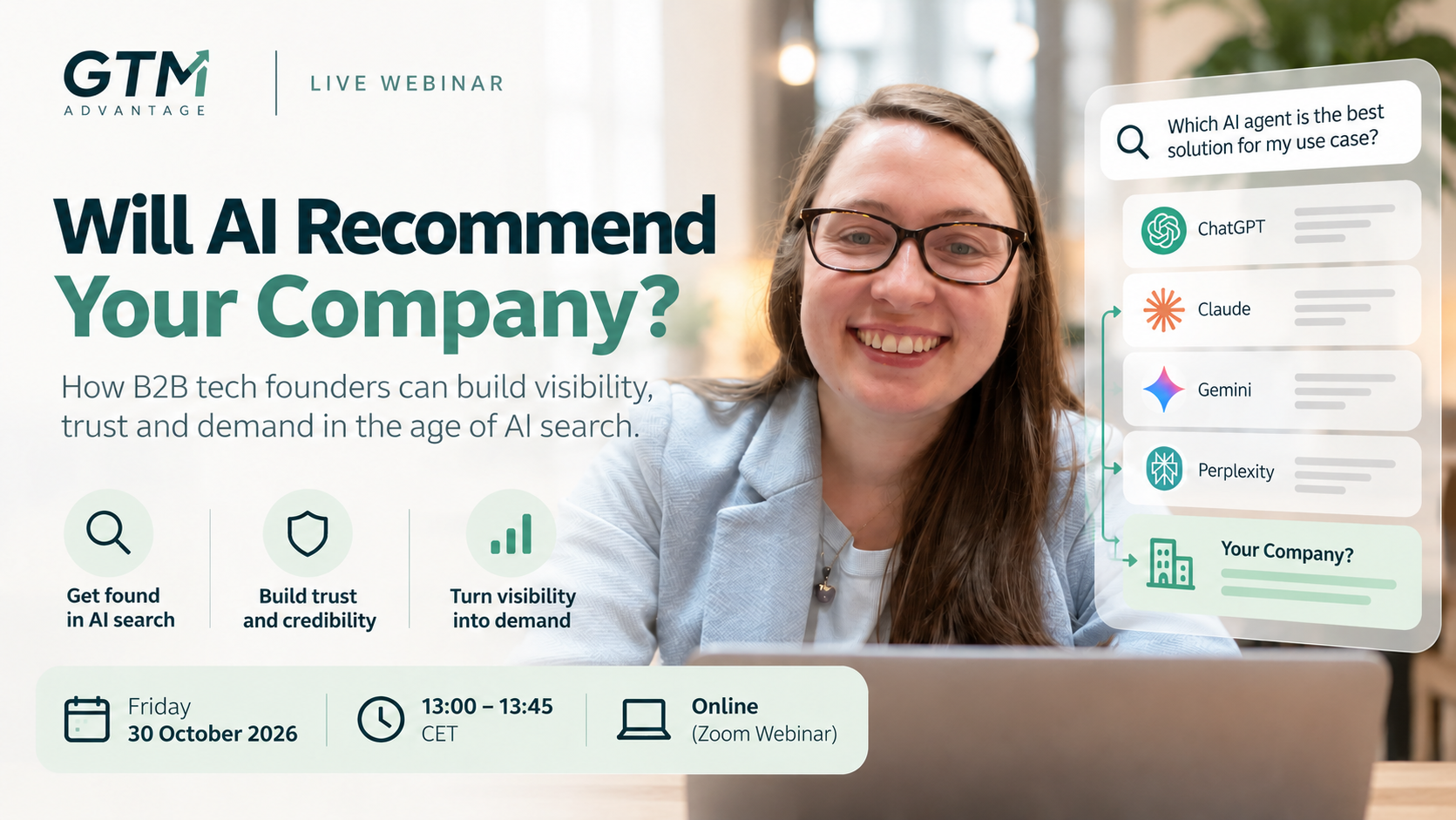
I am hosting a live GTM Advantage webinar focused specifically on AI search: how B2B technology companies can become discoverable and credible in AI-assisted buying journeys, identify the buying questions worth targeting, and connect GEO activity directly to qualified pipeline and not just mentions.
Date: Friday, 30 October 2026
Time: 13:00 – 13:45 CET (12:00 – 12:45 UTC)
Location: Online (Zoom Webinar)
👉 Register for the Webinar Here
Adrijana Daragon | Founder, GTM Advantage | Zurich | B2B Technology Go-To-Market Strategy